
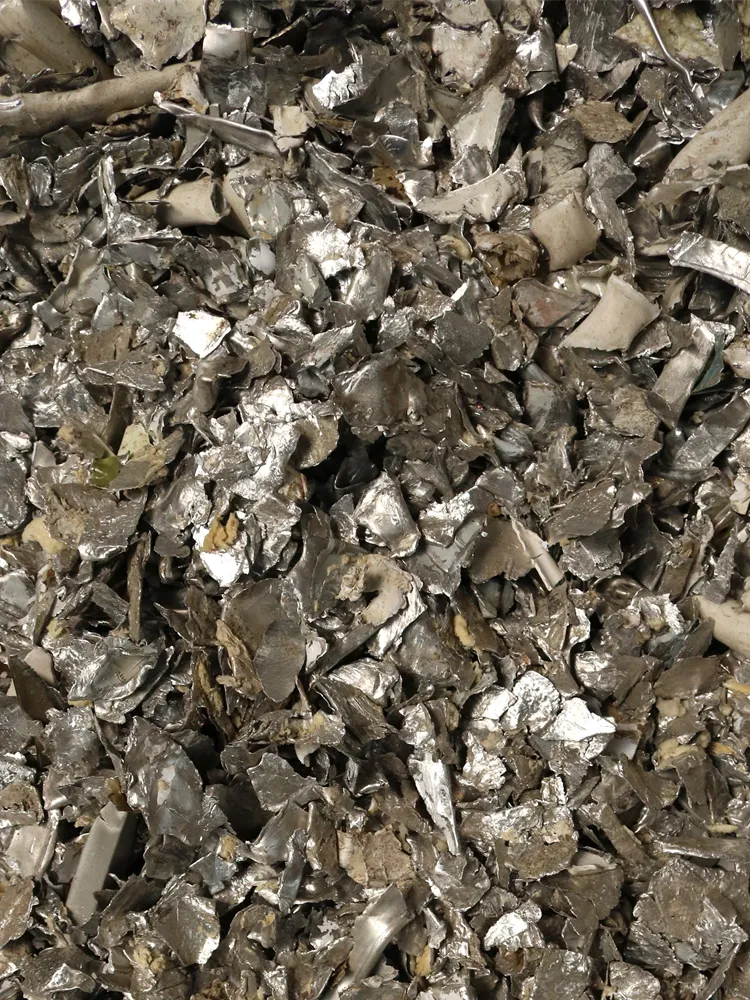
Combustible dust comes in radically different forms, from types such as organic or pharmaceutical, to varying particle sizes and moisture content, and numerous other variables. However, one category of dust is treated much differently than all the rest because of its unique explosible properties, and that is metal dust.
Once a mechanical process begins of grinding, polishing, milling or blasting a metal, the resulting metal dust’s behavior is drastically different, as its particle size is greatly reduced while the total surface area is increased. The behavior of metal dust differs significantly from other types of dust for the following reasons:
Higher Combustion Temperatures - Once ignition occurs in metal dust, the reaction becomes extremely energetic and fast compared to organic or pharmaceutical powders.
More Aggressive Reaction Rates - As particle size decreases, the surface area available for the reaction increases massively. A coarse aluminum chip and fine aluminum dust may be chemically identical material, but from an explosion perspective, they behave completely differently.
Oxide Layer Fracturing - Metal surfaces naturally develop oxide layers that provide a degree of surface stability. However, mechanical processing (grinding, blasting, polishing) continuously fractures these oxide layers, exposing fresh, reactive metal underneath. Because the process is continuous, newly exposed reactive surfaces are constantly being generated. This is the primary reason that shot blasting and polishing dust can become far more reactive than people initially expect.
Rapidly Changing Explosion Parameters Unlike organic dust, where properties are relatively stable and predictable, metal dust exhibits rapidly changing ignition sensitivity, explosion violence, pressurize rates and suppression effectiveness depending on particle morphology and oxidation state. Even the repeatability of testing can become more difficult depending on these factors.
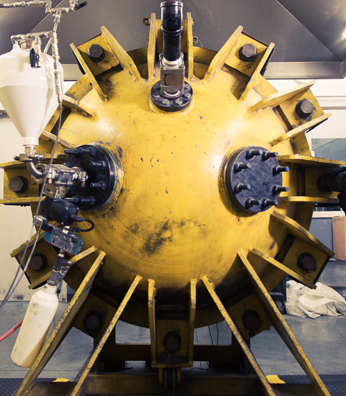
As one of the global leaders in combustible dust testing, Fike has studied metal dust explosibility characteristics for decades. One critical issue that must be addressed is that the standard 20L sphere often does not accurately predict real-world explosion behavior of metal dust.
The 20L sphere scales relatively accurately with the 1m3 vessel for organic dusts. For example as seen in Table 1, the Kst (rate of pressure rise) for cornstarch is measured at 206 in the 20L sphere and 214 in the 1m3 vessel. However, the Kst for aluminum under 45 microns is measured at 162 in the 20L sphere versus 328 in the 1m3 vessel – an increase of 100 percent!
Clearly, safety issues could result if the data from the 20L sphere was used in the design of an explosion protection system for a process handling this aluminum dust.
| Product | 20-L Sphere - Kst (bar m/s) | 20-L Sphere - Pmax (bar) | 1 cubic meter vessel - Kst (bar m/s) | 1 cubic meter vessel - Pmax (bar) |
|---|---|---|---|---|
Cornstarch |
206 |
8.4 |
214 |
8.9 |
Iron |
50 |
3.6 |
64 (+30%) |
4.5 (+25%) |
Zinc |
68 |
4.7 |
95 (+40%) |
6.0 (+30%) |
Silicon |
285 |
8.0 |
124 (-60%) |
9.1 (+15%) |
Aluminum (<45µm) |
162 |
8.0 |
328 (+100%) |
10.1 (+25%) |
Aluminum (<5µm) |
531 |
10.2 |
505 |
10.2 |
Some of the reasons the 1m3 vessel more accurately calculates the explosibility characteristics of metal dust include higher turbulence, more uniform dust dispersion, higher range of dP/dt, and the reaction is fully developed within the larger chamber.
So, because metal dust behaves so much differently than other types of dust, does that mean the protection strategy changes as well?
Not necessarily. The natural explosion protection design progression largely remains the same: explosion venting, explosion venting with ducts, flameless venting and explosion suppression, and then the type of isolation is still usually chosen based on the primary protection strategy. However with that said, some important implications remain:
- Explosion venting with a passive isolation method, both designed to the Kst and Pmax of the metal dust, remains the most cost-effective strategy.
- Protecting indoor applications is far more difficult because free venting is not possible and other solutions such as discharge ducts and flameless venting have many more limitations than they often do with organic dust.
- Explosion suppression may be used on these indoor processes, but due to phenomena like pressure piling and because the dust may burn four times hotter than the temperature of organic dust, significantly more suppressing devices (Fike HRDs) are required to ensure the deflagration is contained.
For these reasons, ideally an explosion protection expert is included in the design stage of the process. The hazardous areas may be identified early in the process and recommended to be located outside, making the process far more safe and the explosion protection system far more cost-effective.
With a combustible dust test lab equipped with both 20L and 1m3 vessels, global consultancy experts and comprehensive explosion protection systems, Fike is one of the world’s leading experts in metal dust deflagration safety.